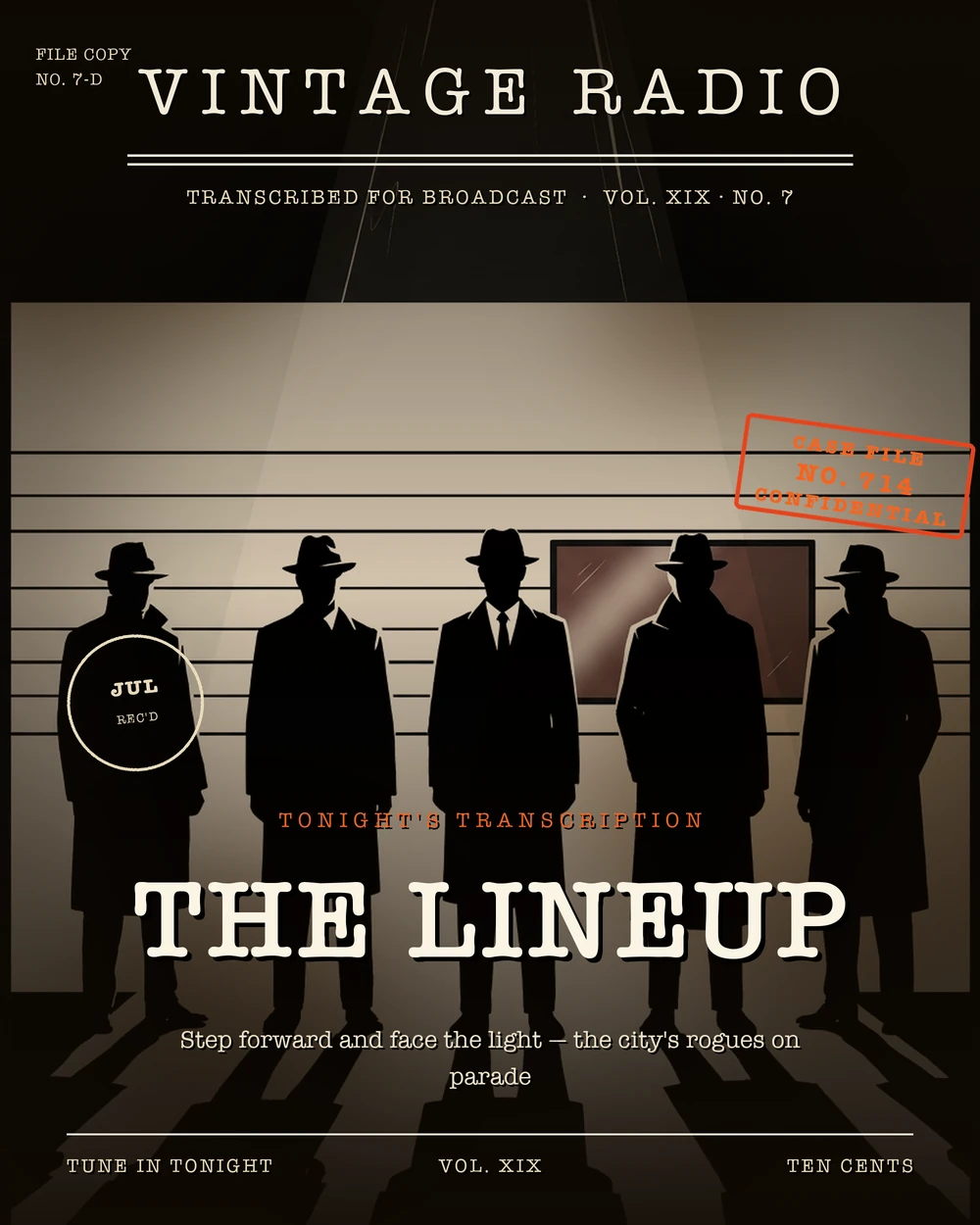
The Lineup
How It Got on the Air
When NBC's Dragnet started pulling in police-drama audiences in the early 1950s, CBS looked for something to put up against it. The answer was The Lineup, which premiered July 6, 1950 as a summer replacement for The FBI in Peace and War. The mandate was straightforward: give listeners the same procedural realism that was making Dragnet a hit, but do it with a CBS cast and a CBS sound. Whether it was a close imitation or something with its own identity became a question critics argued over from the start — a Variety review of the premiere noted that "aside from the lineup angle ... [the episode] hewed to the traditional whodunit pattern." That mixed verdict didn't stop the network from bringing the show back in the fall.
The premise was built around a police headquarters in what the show described only as "a great American city" — no specific location was named during the radio run. Each broadcast opened and closed with an actual lineup scene, where Sgt. Matt Grebb was heard instructing prisoners, establishing both the case and the texture of the working police world. The show's own framing put it plainly: behind the scenes of police headquarters, "where under the cold, glaring lights pass the innocent, the vagrant, the thief, the murderer." It was a more atmospheric pitch than Dragnet's documentation-heavy approach, and it gave the show its own identity even when the scripts ran close to conventional whodunit territory.
The show ran 30-minute episodes on CBS through February 20, 1953, cycling through many timeslots and schedule changes along the way. For most of its run it was sustained — unsponsored — with Wrigley's Gum, Plymouth, and the U.S. Army and Air Force recruiting service each coming on briefly at various points in 1952. The Armed Forces Radio Service also distributed the show to military personnel serving overseas.
The People Who Made It
The first summer of The Lineup was directed and produced by Elliott Lewis, who had a reputation in the industry that made his involvement notable. Lewis had been involved in more than 900 radio productions over his career, enough to earn him the nickname "Mr. Radio" among industry professionals. As an actor he was best known for playing the trouble-making guitar player Frankie Remley on The Phil Harris-Alice Faye Show and for playing Archie Goodwin in a Nero Wolfe series. He directed The Lineup through its first run, then left to take over Suspense — a move many critics consider the most creative period of his work on that program. Jaime del Valle stepped in as producer-director and stayed with the show, and eventually the television version, long after.
The original writing team was Morton Fine and David Friedkin, who set the show's tone in 1950. Blake Edwards came on as a writer at a later point, part of a larger stable that eventually included E. Jack Neuman, Gil Doud, Milton Geiger, Charles E. Israel, Gene Levitt, David M. Light, Sydney Marshall, Richard Quine, and William J. Ratcliff. Del Valle and Edwards both rode with police and watched real lineups as research, and del Valle reportedly read about a dozen newspapers a day, freely adapting true stories into material the show could use without being formally tied to case records the way Dragnet was. The music was composed and performed by Eddie Dunstedter.
The Cast
Bill Johnstone played Lt. Ben Guthrie, the calm, soft-spoken anchor of the two-man team at the center of the show. Johnstone had significant radio history behind him: in 1938 he was selected over 45 other actors to replace Orson Welles as The Shadow, a role he held for five seasons through 1943. He later played Judge James T. Lowell on the daytime television drama As the World Turns from 1956 to 1979.
Playing against Johnstone's measured Guthrie was Sgt. Matt Grebb — quick-tempered and often bored, the kind of cop who did the job because it was the job. Joseph Kearns originated the part, and Wally Maher took over from approximately 1951. Maher had a well-established radio career, including the lead in the Mutual network's Michael Shayne from 1944 to 1947 and the role of police lieutenant Riley on Let George Do It. He was also the original voice of Tex Avery's cartoon character Screwy Squirrel, providing the voice for five MGM shorts between 1944 and 1946. His tenure on The Lineup was complicated by serious health problems — he had suffered from chronic lung conditions throughout his career, conditions that had kept him out of military service during World War II, and in 1950 he had one lung surgically removed. During the 1951 season, Raymond Burr was called in as a temporary replacement on occasions when Maher's failing health prevented him from working. Maher died on December 27, 1951, at 43.
The supporting ensemble drew from the reliable pool of CBS Hollywood regulars — John McIntire, Jeanette Nolan, Sheldon Leonard, Raymond Burr, and Howard McNear all appeared. McNear, who would later become known nationally as Floyd the Barber on The Andy Griffith Show — and who played Doc Adams on Gunsmoke — appeared in nearly every episode of The Lineup, playing a different hapless criminal or suspect each week. Jack Moyles was another regularly featured presence in the ensemble.
What the Show Got Right
Newsweek captured the tone of The Lineup with a line that could have served as the show's thesis: "Everything they do is just a job." Guthrie and Grebb didn't chase glory. They processed people, followed leads, and wrote reports. The show presented police work as routine punctuated by the occasional thing that mattered, and the contrast between the mundane machinery of the lineup and the seriousness of what went through it was where the drama lived.
The CBS sound-effects team contributed substantially to the procedural texture. OTR historians have noted that The Lineup, though often grouped with Dragnet imitators, actually had a stylistic quality closer to the ensemble procedural feel of Gunsmoke — the show worked as an atmosphere piece as much as a plot-delivery vehicle. Unlike Dragnet, which anchored its authority in the claim that its cases came directly from police files, The Lineup made its fictional cases feel real through craft rather than documentation. Del Valle's newspaper-reading habit kept the material grounded without the constraints of working from actual case records — the result was a show that felt observed without being a re-enactment.
After Radio: Television and Film
About a year after the radio series ended, CBS launched a television version of The Lineup on October 1, 1954. The TV series ran for six seasons until 1960, starring Warner Anderson as Lt. Ben Guthrie and Tom Tully as Inspector Matt Grebb — the rank was changed from sergeant to inspector because the San Francisco Police Department's Bureau of Inspectors had no sergeant rank, and the TV version was firmly set in San Francisco, something the radio show had never specified. The series was filmed using Desilu's production facilities but shot extensively on location in the city. It was a Top 20 Nielsen hit for three of its six seasons, finishing number 17 for 1955–1956, number 16 for 1956–1957, and number 18 for 1957–1958. In its final season the show expanded to an hour and introduced new characters, including Policewoman Sandy McAllister played by Rachel Ames. Syndicated reruns aired under the title San Francisco Beat.
Del Valle produced both the television series and a 1958 Columbia Pictures feature film, also called The Lineup, directed by Don Siegel and written by Stirling Silliphant. The film starred Eli Wallach as the psychopathic killer Dancer and Robert Keith as his mentor Julian, with Warner Anderson reprising his TV role. Siegel and Silliphant had both argued for a different title — Siegel suggested "The Chase" — believing audiences would confuse the film with the television series. Del Valle and co-producer Frank Cooper held firm, trusting that the TV show's popularity would help ticket sales. According to TCM, Siegel's fears proved correct: the film generated few ticket sales on release and was dismissed by most critics as an undistinguished crime drama. It has since been reassessed; film scholar David Thomson has called it "very influential" in the development of noir. The film was preserved by the Academy Film Archive in conjunction with Sony Pictures in 1997. Its climactic sequence — a car chase filmed on San Francisco's then-unfinished Embarcadero Freeway — involved stunt driver Guy Way accelerating to top speed before braking inches from the edge, with his wife in the vehicle, unaware of what he planned to do.
What Survives
Scripts for The Lineup and related printed material are held in the KNX Collection at the University of California, Santa Barbara Library — approximately 120 boxes of material, donated to UCSB as part of the American Radio Archives in 2021. Of the 118 episodes from the CBS radio run (plus one audition show), 73 have been identified as surviving. A certified accurate set was issued in August 2015, representing the most complete and reliably identified surviving collection — a significant effort, since many circulating recordings had been assigned incorrect dates or titles by collectors over the years.